If you’ve worked in product development for any length of time, you’ve probably encountered the confusion around documentation. Take different companies and you’ll find the same documents used under different names. What one team calls a PRD, another might call a product brief or feature spec. In some organizations, an MRD and BRD exist as separate documents, while in others those functions get absorbed into a single PRD. Agile teams sometimes operate with nothing but user stories, whereas large enterprises in regulated industries maintain stacks of documentation.
This variability creates real problems. When you switch companies, you might assume everyone uses the same terminology, only to discover that “BRD” means something completely different in your new workplace.
This article gives you a clear map of how these documents differ, what questions each one answers, who creates them, and how they fit together. With that understanding, you can build a documentation process that serves your team, your product, and your industry.
Quick Summary: All Documents at a Glance
Before we dive into the details, here is a quick reference table showing the big picture.
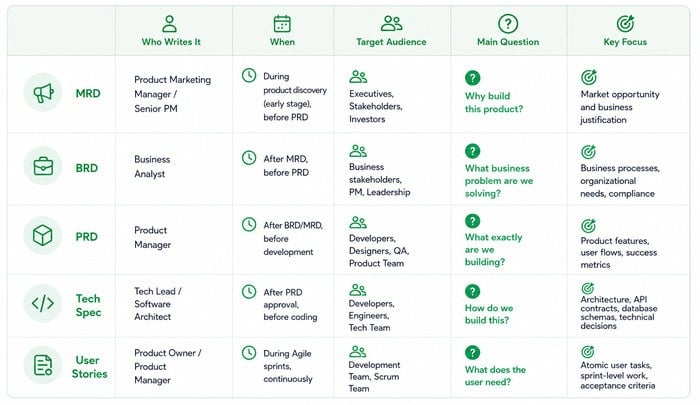
The MRD focuses on market opportunity and whether a product makes business sense. The BRD zooms in on business processes and organizational needs. The PRD translates those business needs into concrete product features. The Tech Spec details the technical implementation. And user stories break everything down into atomic, actionable tasks for Agile teams.
Each document serves a different audience and answers a different question, though in practice there is often overlap.
MRD – Market Requirements Document
The Market Requirements Document, or MRD, is a strategic document that explores whether there is a market opportunity worth pursuing before anyone writes a single line of code or sketches a single feature. It answers the fundamental question of why you should build this product at all.
Product marketing managers or senior product managers write the MRD — the people who talk to customers daily, attend industry conferences, and track competitor moves. They are the ones who notice patterns: that competitors are charging premium prices for features nobody uses, or that a new regulation is creating demand for compliance tools.
The MRD is written during the discovery phase, well before any PRD exists. This is when the team is still deciding whether to greenlight the product. Some companies never create formal MRDs, especially startups moving fast. But in larger organizations, the MRD gets presented to executives for approval.
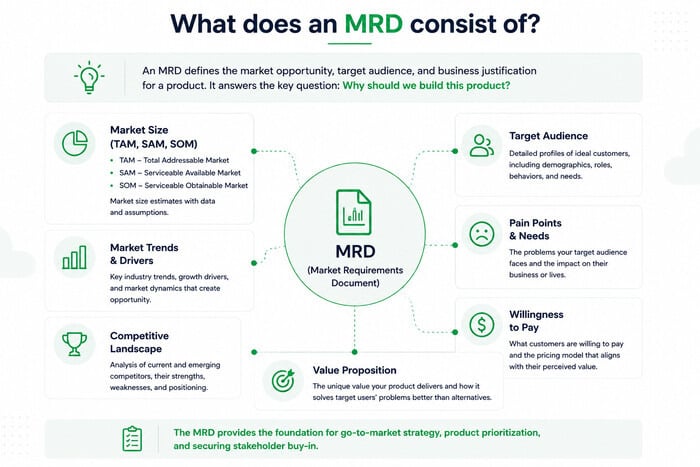
What does an MRD consist of? You’ll find market size estimates broken down into TAM, SAM, and SOM (total addressable market, serviceable available market, and serviceable obtainable market). You’ll see detailed profiles of the target audience, their pain points, and what they are willing to pay. There is competitor analysis mapping out who else is fighting for this market, their strengths, their weaknesses, and where you might differentiate. And there is a business case with revenue forecasts, cost projections, ROI calculations, and timeline estimates.
The MRD also describes potential risks: what could go wrong, what the barriers to entry are, and what regulatory hurdles exist.
The key distinction between MRD and PRD comes down to focus. The MRD answers “why” from a market perspective — why does this product need to exist, why will customers buy it, why is now the right time. The PRD answers “what” — what specific features will we build, what user problems will we solve, what functionality defines the product.
The MRD talks to executives and investors in business language about markets and money. The PRD talks to developers, designers, and testers in product language about features and user flows.
BRD – Business Requirements Document
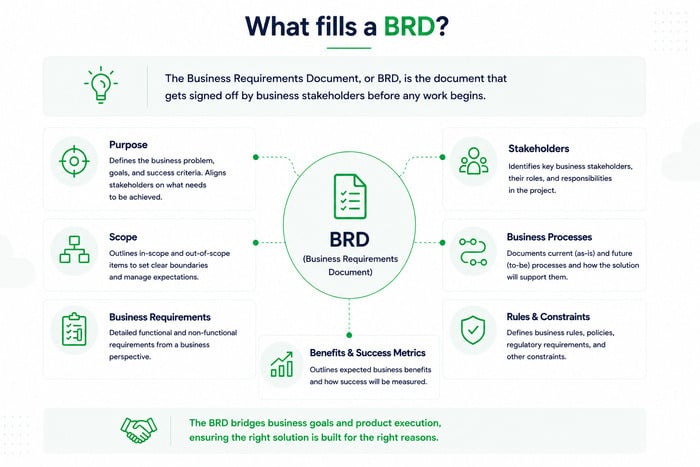
The Business Requirements Document, or BRD, is where things get interesting. In some companies, you’ll never see a BRD. In others, especially enterprise environments, banks, healthcare organizations, and government contractors, the BRD is non-negotiable. It is the document that gets signed off by business stakeholders before any work begins.
The BRD captures what business problem we are solving and how solving it fits into the larger organizational picture. It’s less about whether customers will buy something and more about whether this initiative makes sense for the business itself.
Business analysts write the BRD. These are professionals trained in process mapping, requirements elicitation, and gap analysis. They interview stakeholders across the organization, observe current workflows, document existing systems, and identify where things break down.
Timing matters here. The BRD appears after the MRD validates market opportunity but before the PRD defines product features. In simple terms: the MRD says there is a $50 million market opportunity. The BRD says here’s how we’ll capture it given our current capabilities, budget constraints, and strategic priorities.
What fills a BRD? Business goals and objectives come first: reducing customer churn by 25%, increasing upsell revenue by $3 million, or cutting operational costs by 15%. These are concrete targets tied to business value.
Current business processes get documented in detail.
- How does work actually happen today?
- What systems are involved?
- Where do errors occur?
This is crucial because you can’t design a solution without understanding the problem space.
In regulated industries, compliance requirements become a major section of the BRD.
- What regulations apply?
- What audit trails are needed?
- What data retention policies must we follow?
- What security standards must be met?
Key performance indicators get defined here too — how will we know we’ve succeeded, what metrics matter, how will we measure them. The BRD also captures budget constraints and resource requirements.
The relationship between BRD and PRD varies by organization. In traditional enterprise settings, the BRD is so detailed that it essentially replaces the PRD. The business requirements are specific enough that developers can build directly from them. In product-centric companies, both documents coexist.
The practical difference: the BRD talks about business processes, organizational changes, and internal metrics. The PRD talks about user-facing features, customer experiences, and product functionality. The BRD might say “reduce manual data entry by 80%.” The PRD says “build an automated import feature that pulls customer data from CSV files.”
PRD – Product Requirements Document
If the MRD is about market opportunity and the BRD is about business needs, the PRD is about the actual product. It’s the bridge between business requirements and technical execution, translating abstract goals into concrete features that developers can build.
The PRD describes what you are constructing, who it is for, and what capabilities it needs. It defines user flows, feature specifications, success metrics, and acceptance criteria. It is detailed enough that a development team can start working with it without constant clarification, but it does not specify implementation approaches. That belongs to the Tech Spec.
Product managers write the PRD. It is their primary tool for communicating product vision to the entire team.
The PRD appears after market validation but before development begins. Write it too early, before you understand the market or business constraints, and you’ll build the wrong thing. Write it too late, after coding has started, and it leads to constant rework.
A complete PRD includes:
- Product vision and strategy — the purpose and direction.
- Target users and their needs — who you are building for and what problems you are solving.
- Prioritized feature list — what is in scope for this version versus future releases.
- User flows and interactions — how users will navigate and use the product.
- Success metrics — the data that will show whether the product is working.
- Acceptance criteria — clear definitions of when a feature is truly complete.
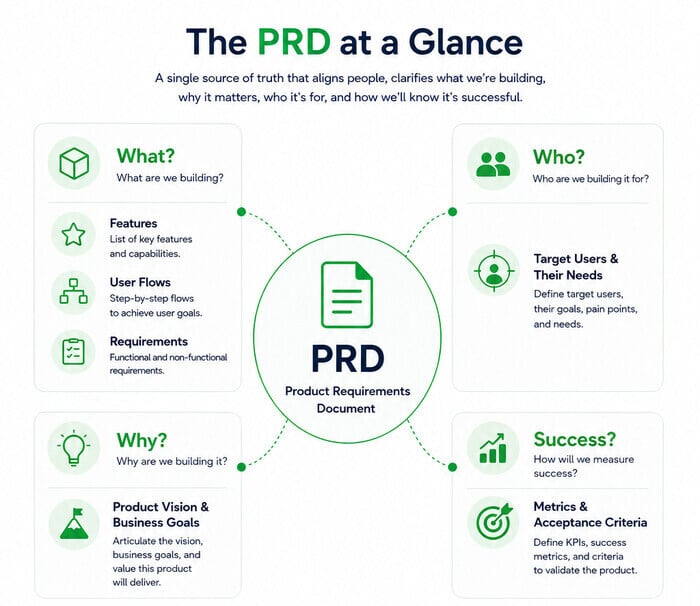
In short, the PRD consolidates the what, who, and why of your product into one reference document. It says users need to export reports to CSV — not that we’ll use a specific library to generate CSV files. It says the system must handle 10,000 concurrent users — not that we’ll use Redis for caching. Those details belong to the Tech Spec.
For a full breakdown of PRD structure and how to write one, see What Is a PRD.
Tech Spec – Technical Specification
Once the PRD defines what we are building, someone needs to figure out how to build it. The Technical Specification is an engineering document that translates product requirements into concrete technical decisions.
Tech leads or software architects write the Tech Spec, after the PRD gets approved but before development starts. This timing allows engineers to understand the technical approach before writing code and gives stakeholders visibility into decisions that might affect timeline or feasibility. Sometimes the Tech Spec reveals that what looks simple in the PRD is technically complex, prompting conversations about scope adjustments before any code is written.
A Tech Spec contains architectural decisions showing how different system components fit together. It defines API contracts and endpoints, specifying request/response formats and error handling. Edge cases and error scenarios get enumerated: what happens when the network fails, when data is malformed, when users act unexpectedly? Technology stack choices get documented with rationale — why this database, why this cloud provider.
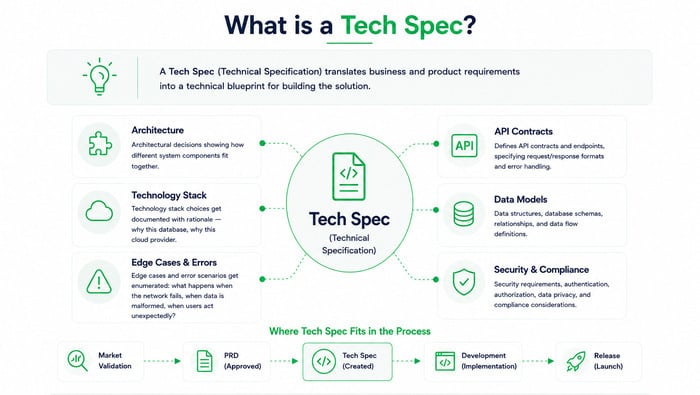
The critical distinction between PRD and Tech Spec is what versus how. The PRD says users need real-time dashboards showing sales data. The Tech Spec says we’ll use WebSocket connections for real-time updates, Redis for caching aggregated data, PostgreSQL for persistent storage, and GraphQL for flexible querying. The PRD is product-oriented and user-focused. The Tech Spec is engineering-oriented and system-focused.
A common mistake is merging the PRD and Tech Spec into one document. This creates confusion because different audiences have different needs. Product managers, designers, and QA testers don’t need to know about database schemas or API implementations. Developers don’t need lengthy explanations of user benefits and market positioning. Keeping them separate also allows parallel work streams: while engineers draft the Tech Spec, designers can refine UI mockups and QA can start planning test cases.
User Stories
User stories represent a different approach to requirements altogether. Instead of a comprehensive document created upfront, user stories are short, atomic descriptions of functionality written from the user’s perspective. They follow a simple template: “As a [user type], I want [goal], so that [benefit].”
Product owners or product managers write user stories, though in healthy teams developers, designers, and even customers contribute. User stories emerge continuously throughout the Agile process, written and refined during sprint planning. They are living artifacts that evolve as the team learns more.
Beyond the user role, goal, and benefit, user stories include acceptance criteria, often written in Given/When/Then format (sometimes using Gherkin syntax), that define exactly when a story is considered complete.
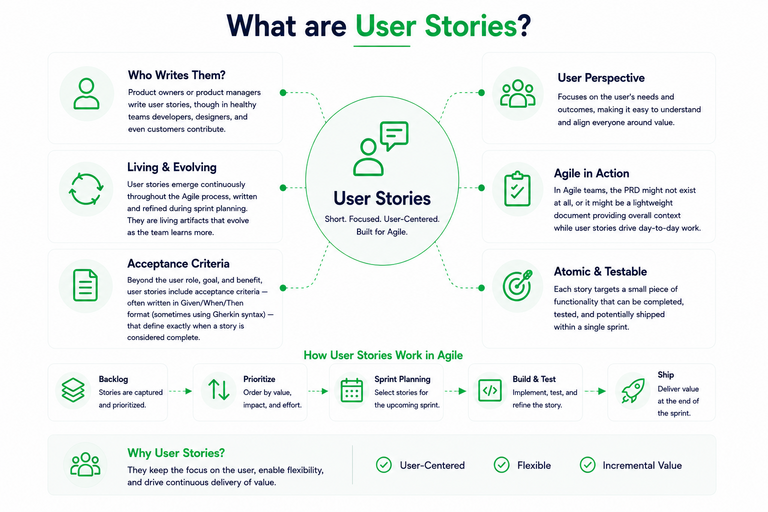
In Agile teams working with user stories, the PRD might not exist at all, or it might be a lightweight document providing overall context while user stories drive day-to-day work. The team maintains a backlog, prioritizes stories, and pulls them into sprints. Each story gets implemented, tested, and shipped within a single sprint.
The key difference from a PRD is scope. User stories are atomic and iterative — written incrementally throughout development as the team learns more. The PRD is holistic and upfront, created before development begins and capturing the complete product vision. User stories focus on individual features or actions in isolation; the PRD shows how everything fits together.
How These Documents Connect in Practice
Understanding individual documents is useful, but the real value comes from seeing how they chain together. Take a B2B SaaS team launching a new analytics feature.
It starts with the MRD. The product marketing team notices a pattern during customer interviews. Forty percent of enterprise prospects mention needing advanced reporting capabilities during sales conversations. Competitor analysis reveals that while all competitors offer basic reporting, none provide real-time analytics or custom dashboard creation. Market research sizes this opportunity at $50 million annually across the target segment.
Next comes the BRD. The business analyst works with the customer success team and reviews support tickets. They discover that customers spend an average of 15 hours per week manually creating reports in Excel because the existing system can’t generate what they need. This leads to frustration and contributes to 8% annual churn. The business goal becomes reducing churn by 25% and increasing upsell revenue by $3 million through the analytics feature.
The PRD translates these business needs into product specifics. The product manager defines the real-time analytics dashboard with concrete features: custom report builder with drag-and-drop interface, 15 pre-built visualization types, CSV and PDF export functionality, role-based access control with granular permissions, and scheduled report delivery via email.
The Tech Spec details how engineering will implement all of this. The tech lead specifies a microservices architecture with a dedicated analytics service separate from the main application. API endpoints are defined with OpenAPI specifications. The database schema uses PostgreSQL with the TimescaleDB extension for time-series data. Redis handles caching for frequently accessed aggregations.
Finally, user stories decompose the PRD into sprint-sized work:
- “As a manager, I want to create custom reports with filters so that I can track metrics specific to my team’s performance.”
- “As an analyst, I want to export report data to CSV so that I can perform offline analysis in Excel.”
- “As an admin, I want to control user permissions at the folder level so that sensitive data remains accessible only to authorized teams.”
- “As a viewer, I want to schedule reports to be emailed weekly so that I receive updates without manually generating them.”
Each story includes acceptance criteria, prioritization, and estimation points.
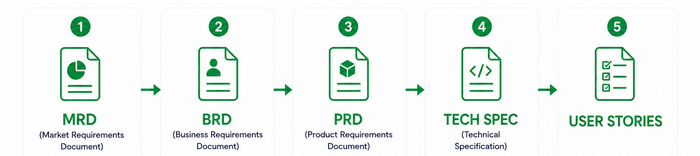
This example shows traceability from market opportunity through business justification to product features, technical implementation, and individual tasks. If someone asks why you are building something, you can trace it back through the documents to the original market need.
When You Actually Need Each Document
The right documentation depends on your context: team size, product complexity, industry requirements, and development methodology. Here are three common scenarios.
Startup or small team building a new product
PRD plus user stories are sufficient. You’re moving fast, resources are tight, and close daily communication means you don’t need formal handoffs. The lightweight PRD captures the product vision, target users, core features, and success metrics — probably 5–10 pages, not 50. User stories drive sprint execution. You skip the MRD because you have already validated the idea through customer conversations. You skip the Tech Spec because the tech lead explains the architecture in a design doc or in conversation.
This approach works brilliantly when it works. But as you grow, the lack of documentation becomes a liability. New team members struggle to understand decisions. Knowledge lives in people’s heads rather than in documents.
Medium-sized product with multiple teams using Agile
Once you have multiple teams working on the same product, you need more structure: PRD plus Tech Spec plus user stories. The PRD ensures all teams understand the product vision and how their work fits together. The Tech Spec provides technical coherence across teams so Team A’s API works with Team B’s frontend. User stories enable agile delivery within each team.
The PRD is more comprehensive now — probably 20–30 pages with detailed feature specifications, user flows, and integration requirements. The Tech Spec is essential because you can’t have five teams guessing at architecture. User stories remain the engine of sprint execution, organized by team and coordinated through program-level planning.
Enterprise, outsourcing, or regulated industry
In these environments, you need the full set: MRD plus BRD plus PRD plus Tech Spec. Compliance requirements demand comprehensive documentation.
The MRD justifies the investment to executives and investors — a formal business case with market analysis, financial projections, and risk assessment. The BRD is exhaustive, documenting every business process, compliance requirement, and constraint, possibly 50+ pages reviewed and signed off by multiple stakeholders. The PRD is comprehensive, leaving no ambiguity about what’s being built. The Tech Spec is rigorous, covering every technical decision with rationale.
In banking, healthcare, or government contracting, missing documentation can mean failed audits, lost contracts, or legal liability.
Conclusion
There is no universal set of documents that works everywhere. The right documentation depends entirely on your situation — a 5-person startup building a consumer mobile app needs something very different from a 500-person enterprise building medical device software.
What matters is understanding what question each document answers: market opportunity, business justification, product definition, technical implementation, or sprint-level tasks. Once you know that, you can decide which ones your team actually needs and skip the rest.
If you want to go deeper on PRDs specifically, these resources are worth exploring:
- What Is a PRD covers the basics: definition, standard structure, advantages and disadvantages, and when PRDs make sense versus when they don’t.
- PRD in the Age of AI explores how artificial intelligence is changing the PRD writing process.
Good luck with your technical writing!
Author, host and deliver documentation across platforms and devices
FAQ
Do I need all five documents for every project?
No. The right set depends on your team size, industry, and development process. A startup can ship successfully with just a PRD and user stories. The full stack — MRD, BRD, PRD, Tech Spec, and user stories — makes sense for enterprise environments, regulated industries, or large multi-team products. See the “When You Actually Need Each Document” section above for specific scenarios.
What’s the difference between a PRD and a Tech Spec in practice?
A simple test: if the sentence starts with “users can…” or “the product should…”, it belongs in the PRD. If it starts with “the system will…” or “we’ll use…”, it belongs in the Tech Spec. The PRD is written for anyone on the product team. The Tech Spec is written for engineers.
Can user stories replace a PRD entirely?
In Agile teams, yes — and it’s common. User stories work well when the team is small, communication is tight, and requirements can evolve sprint by sprint. The trade-off is that user stories don’t give you a complete picture of the product in one place. If you need stakeholder alignment, onboarding new team members, or a paper trail for compliance, a PRD holds up better.
Who owns each document — and what happens when there’s no dedicated role?
In theory: PM owns the PRD, business analyst owns the BRD, product marketing owns the MRD, tech lead owns the Tech Spec. In practice, especially at smaller companies, the PM often writes or contributes to all of them. The important thing is that someone owns each document — ambiguous ownership usually means the document never gets written or never gets updated.
When does a BRD make sense vs. just using a PRD?
The BRD earns its place when the project involves significant organizational change, legacy system integration, or regulatory compliance. If you’re building a new SaaS feature for a startup, a BRD is overkill. If you’re replacing a core banking workflow in a financial institution, the BRD is probably the most important document in the stack.
What if our company uses these terms differently?
That’s completely normal. Terminology varies widely across industries and organizations. What matters isn’t the label — it’s understanding what question the document answers and who it’s written for. If your company calls the PRD a “product brief” and the Tech Spec a “design doc,” the underlying logic is the same.