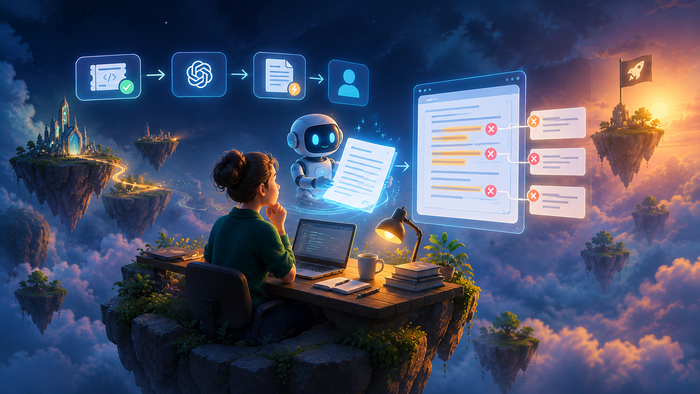
A technical writer asks an AI tool for a favor: “Draft documentation for feature X” — a feature that shipped to users three weeks ago. The tool returns a polished, well-structured draft in under a minute. It reads like professional, natural human writing, and it fits the tone of voice of the rest of the documentation set perfectly.
There’s just one problem: the draft is wrong in three places. The ticket the AI used as its source had been silently overridden by a design decision that was never recorded anywhere the writer — or the AI — could see.
This isn’t a story about AI being unreliable. It’s a story about timing. The AI removed the friction of composing the text, but it did nothing about the writer’s access to reliable information. The real question was never “how fast can this get written?” It’s “at what point does trustworthy information about this feature exist, and is the writer in the room when it does?”
If the answer is “after release,” AI doesn’t solve the documentation problem — it automates the production of plausible-sounding misinformation. That’s the real question behind where the technical writer belongs in the software development lifecycle, and AI has changed what’s at stake in answering it.
Where Documentation Sits in the SDLC – In Theory and in Practice
The traditional SDLC chain: requirements, design, development, testing, release, support, implies that decisions flow forward and documentation simply follows along at the end.
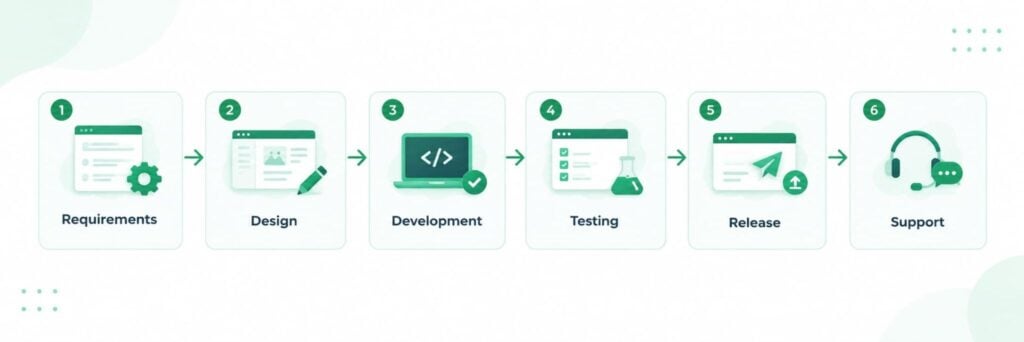
In practice, the decisions that determine what documentation must say (terminology, edge cases, default behavior, user-facing strings) are made during requirements and design. Documentation, meanwhile, is traditionally attached to testing and release — the two stages where those decisions are already settled, often through informal channels the writer never saw.
Here’s what that looks like on the ground: a design team decides a new file upload feature should support files up to 100 MB. The decision is made in a meeting and never makes it back into the ticket. During development, engineers hit performance issues and quietly lower the limit to 50 MB. The writer picks up the ticket two weeks after release, documents the limit as 100 MB, and publishes it. Users start reporting upload errors between 50 and 100 MB. The writer never knew the limit had changed — and neither did the AI, which was fed the same outdated ticket and reproduced the same error, just more fluently.
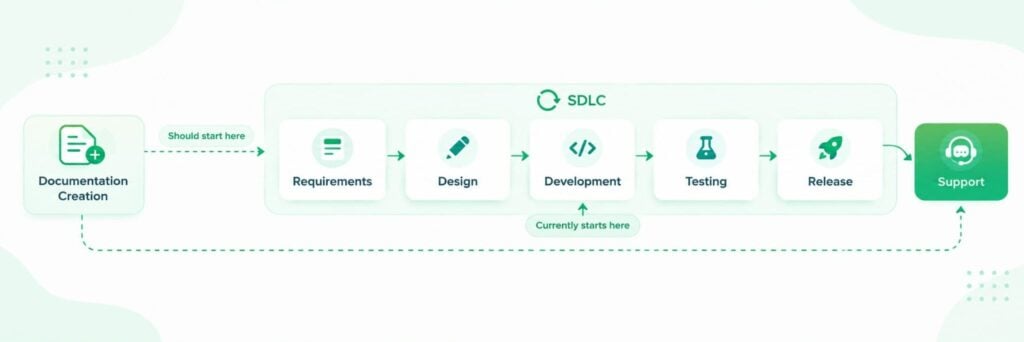
This isn’t a failure of Agile or Waterfall. It’s a structural mismatch. The people who define the product work at the front of the cycle; the people who explain it are brought in at the back — not because anyone thinks documentation is unimportant, but because it’s still treated as a report on what was already built, rather than a factor shaping the process from the start.
The Default Pattern: Writers as the Last to Know
Here’s the pattern that plays out in most teams:
- The writer attends sprint planning as an observer, not a contributor.
- Tickets are refined, estimated, and assigned without the writer reviewing them.
- Development proceeds. Terminology emerges organically in Slack threads and PR comments.
- The writer receives the ticket near release with a note: “Please document this.”
- Support tickets later arrive saying “the documentation says something different from the real product.”
This isn’t a writer failure — it’s a process failure. By the time the writer sees the feature, three developers have already named the same concept three different ways, and edge cases have been resolved in code reviews the writer never read. The product has coherent behavior; the writer’s understanding of it is reconstructed from fragments.
The closest analogy is localization. A translator receives a string with no context: the button labeled “Submit” that reads perfectly naturally in translation is actually meant as “Confirm” in a two-step payment flow — a distinction the product team discussed in a meeting the translator never attended. The translation is grammatically correct and still wrong, because the context the team assumed was obvious never reached the person doing the work.
Should Writers Get Early Access to Specs and Tickets?
There’s no universal answer here. Pull writers into everything and they lose the time they need to actually write. Exclude them from everything that matters and they end up documenting features they don’t understand.
The case for early access: a writer reading a raw ticket catches ambiguity before a line of code is written — because explaining a feature to a user is impossible if the feature itself is unclear. Early access also lets terminology get locked in once, instead of after three developers have already picked three different names for the same thing in Slack. And writers tend to ask the questions developers don’t think to ask, precisely because they don’t already know the system as well.
The case against blanket early access: not every task needs a writer at the concept stage. Internal refactors, performance work, and infrastructure changes usually have zero user-visible impact, and pulling a writer into every planning conversation just creates noise and eats into the time left for actual writing.
The practical filter is narrower than “always” or “never”: bring the writer in early specifically for changes that affect user-visible behavior (API surfaces, default values, rate limits, interface copy, error messages, onboarding flows) and leave internal changes alone, since documentation won’t reflect them anyway.
What Changes When AI Is the One Drafting
When writers wrote documentation by hand, the deciding question was always whether they’d finish in time. Late involvement meant rushed drafts or missed releases — production speed was the bottleneck.
That bottleneck is gone. AI now drafts documentation from tickets, code comments, and commit histories faster than any human could. But it only writes from what it has access to — if the source material is incomplete, outdated, or ambiguous, the draft inherits those flaws, or the model fills the gaps with confident, plausible details that never actually happened.
An AI draft can’t be more accurate than its source. It can only sound like it is.
That reframes the technical writer’s role with AI in four ways:
- The writer’s core job shifts from composing text to maintaining the source of truth — the glossary, the canonical specs, the terminology that both the writer and the AI draw on. A clean source produces a usable AI draft; a fragmented one produces a confident-sounding trap.
- Verification becomes the central activity, not a final check. The writer has to validate AI-generated drafts against actual system behavior, not just against what the ticket says — because the ticket itself may already be stale. The code is the real authority, and the writer needs access to it, or at least to a test environment.
- The writer becomes the guardian of consistency across the whole documentation set. When terminology changes, it has to change everywhere — starting with the glossary, so the AI picks up the new term in every draft after that.
- Documentation is no longer read only by people. AI agents and support bots now treat it as authoritative input. An inaccuracy that once confused a single reader now gets reproduced automatically, at scale, in fluent and confident prose — and the cost of that one error multiplies with every system that relies on it.
That’s why early access to specifications has stopped being a courtesy to the writer and become a precondition for AI-generated documentation: it’s what makes an AI draft something that can actually be verified and published without risk. A writer left out of the room when decisions are made can’t maintain the source of truth — and the AI will inherit every gap that leaves behind.
A Practical Model: Writer Touchpoints by SDLC Stage
This model isn’t a rigid prescription — it’s a framework for what the writer should be doing, and producing, at each stage.
| SDLC Stage | What the Writer Does | Outcome |
| Requirements | Reads raw specs, flags ambiguities, unclear terms, missing edge cases | Glossary entries, list of open questions |
| Design | Reviews the decision for explainability; proposes interface copy | Draft outline, early UI copy |
| Development | Validates AI drafts against tickets and actual (not theoretical) code behavior | Docs-as-code PRs, corrections fed back into specs |
| Testing | Runs documentation through the same test cases QA uses | List of “doc says X, system does Y” discrepancies |
| Release | Finalizes release notes and updated sections | Release notes, deployment-ready docs |
| Support | Collects feedback from users and support tickets | Corrections based on actual usage |
At the requirements stage, the writer doesn’t need to sit in on every meeting — but needs access to the spec and a clear line to ask questions, with a named contact and a response time built into the process. At design, one question does most of the work: “Can I explain this to a new user in one clear sentence?” If not, that’s a signal for the developers, not just a documentation gap. During development, the writer validates AI output against what the code actually does, not what the ticket claims (where most discrepancies surface.) At testing, documentation gets treated as test material: if it passes the same cases QA runs, it’s probably accurate. At release, the writer confirms the release notes reflect shipped behavior, not the originally planned one. At support, user questions feed straight back into the next round of corrections.
Handled this way, documentation becomes a living part of the product rather than a deadline attached to the end of it.
Common Mistakes
Teams adopting this model (or experimenting with AI-assisted documentation) usually make the following common mistakes:
- The writer learns about a feature at release, not at the requirements stage. AI makes this worse, not better — a fast draft that arrives too late to be checked against design intent is still too late.
- AI drafts get published without verification against actual system behavior. Fluency gets mistaken for accuracy — the most dangerous mistake in an AI-assisted workflow, because confident prose is hard to doubt.
- There’s no single source of truth. The glossary lives in a Google Doc, the spec lives in Jira, the AI draws from the code repository — three different versions of “what’s true,” guaranteed to drift apart.
- The writer gets pulled into every discussion regardless of impact. This defeats the purpose of early access — filtering by user-visible impact is what makes it sustainable.
- Documentation updates aren’t part of the Definition of Done. If it’s not a completion criterion, it stays an afterthought no matter when the writer gets involved.
- The writer treats the AI draft as a finished product instead of a starting point. The AI’s value is speed; the writer’s value is judgment. Confusing the two just produces polished inaccuracy.
Tools for Making This Work
No single tool solves this — but the right toolchain makes the model workable:
- An issue tracker that gives the writer read access to tickets from creation, not as a special permission but as a normal part of the workflow.
- A docs-as-code setup that ties documentation to the same version history as the code.
- An AI drafting tool that generates first drafts from tickets and code, saving time while leaving verification to the writer.
- A documentation platform with versioning, structured content, and a shared glossary that serves as the source of truth for both people and AI.
ClickHelp is a good example of a help authoring tool built around that last piece: a centralized, versioned space where terminology lives in glossaries, content stays structured, and both writers and AI tools draw from the same source — instead of three different answers to “what’s true” scattered across a Google Doc, a wiki, and a code repository.
Conclusion
Late writer involvement used to mean exhausted teams and rushed releases. Now it means inaccuracies get reproduced automatically, fluently, and at scale — including for the AI agents that read documentation instead of people. The real shift isn’t that documentation gets written faster. It’s that the technical writer’s role moves earlier in the cycle: from recording what was built to defining what counts as true, for colleagues, for users, and for the models that now treat that documentation as their source of knowledge.
Get that right, and AI becomes a force multiplier. Get it wrong, and you’ve simply automated the production of plausible, polished fiction.
Good luck with your technical writing!
Author, host and deliver documentation across platforms and devices
FAQ
When to involve a technical writer in an AI-assisted workflow?
Not for every task — but early, specifically for changes that affect user-visible behavior: APIs, defaults, limits, interface copy, error messages. Internal refactors with no user-facing impact don’t need the same access.
Does a technical writer need early access to specs and tickets, or is that overkill?
It’s not overkill once AI is drafting the documentation. Technical writer early access to specs is what lets someone verify an AI draft against the decisions that actually shaped the feature — without it, both the writer and the AI are working from an incomplete picture.
Why does documentation keep falling behind development, even with AI?
Documentation falling behind development was never really a writing-speed problem — it’s a timing problem. The decisions that define documentation content happen during requirements and design, while documentation is attached to testing and release. AI drafts faster, but it can’t move the timing of when accurate information becomes available.
Can you trust AI-generated documentation accuracy?
Only as much as you trust its source. AI-generated documentation accuracy is a direct function of ticket and spec quality — a clean, current source produces a usable draft, and a stale one produces a fluent, confident error.
How does a docs as code workflow change the technical writer’s role with AI?
A docs as code workflow ties documentation to the same release cycle as the product, which forces the question of timing into the open. Combined with AI drafting, it shifts the technical writer’s role with AI from writing text to maintaining the glossary and specs the AI drafts from, and verifying what comes out the other end.